Remember the Pebble smart watch? The device that originally came out in 2012 could be considered the OG of smart watches, and was pretty radical for its time.
I backed the Kickstarter campaign for the original black and white model and wore it for many years until the battery capacity dropped to only last for two days, and stopped wearing watches entirely for a while. That’s quite ironic, considering that even for present day smart watches, a two day battery life would be considered pretty good.
The Pebble company released a few more models, introducing round versions and a limited color palette, but eventually went bust. The intellectual property ended up at Google, and the community maintained Rebble - basic infrastructure to keep the watch ecosystem running.
Early 2025, Google open-sourced the intellectual property, and one of the original Pebble people decided to build new watches running a modernized version of the OS.
Naturally, there was some drama between the open source effort to keep the ecosystem alive and budding commercial efforts to build something new. Rebble had archived apps and watch faces that Core Devices, the commercial entity building the new watches, wanted to provide on the revived Pebble platform so the new devices don’t start with an empty experience.
Fortunately, it seems that this drama was resolved peacefully, so I didn’t have to feel bad about my pre-order for the Pebble Time 2, successor of the Pebble Time, which was the original color display model.
What am I looking for in a smart watch?🔗
Surprisingly little, to be honest. The first time getting a gadget of a new class, it’s exciting and new, and I need to try all the things that can be done with it.
Novelty wears off eventually, so my relatively mature requirements are now:
- Tells the time (duh).
- All-day heart rate monitoring.
- Physical activity tracking.
- At least one week of battery life.
- Filtered notification forwarding from the phone.
- Tells the weather.
Before, I’ve been using the CASIO G-Shock GBD H1000-1ER with GPS, heart rate monitoring, temperature, and barometer sensors. It also could do notifications, but it was quite buggy around syncing the visibility state of notifications between watch and phone, so I usually had to dismiss them twice, and turned that feature off effectively.
That watch was amazing in terms of battery life: A single charge easily powered it for a month, aided by built-in solar power.
I would have kept using this watch as daily driver if I hadn’t been so nostalgic about Pebble when the new devices were announced.
First impressions of the Pebble Time 2🔗
I finally received my pre-order a little over 2 weeks ago.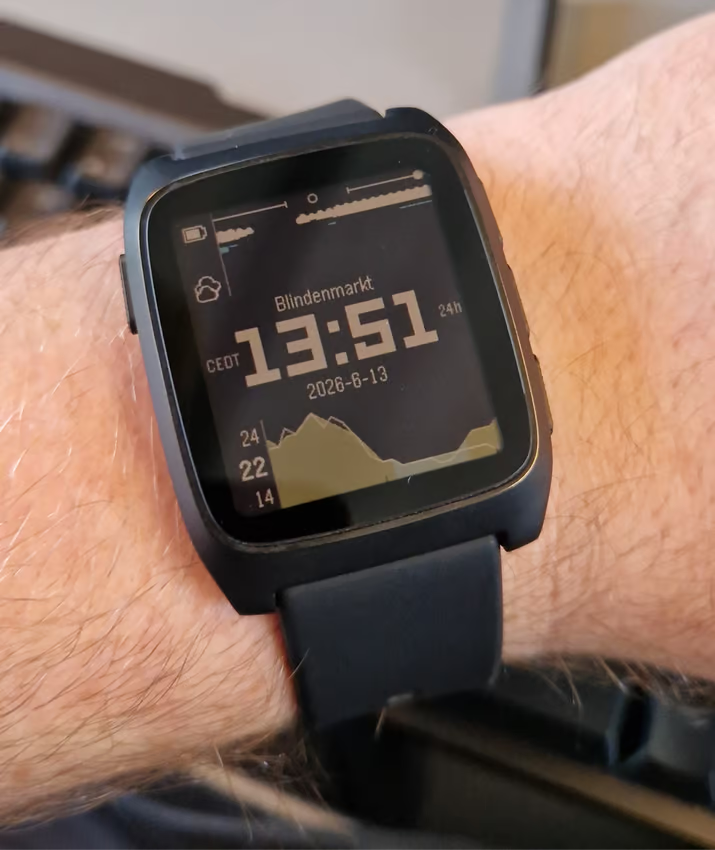
Build quality is great, and all my requirements are satisfied.
After 2 weeks of continuous use, I recharged the watch for the first time, with 21% of battery still remaining. That’s a big check mark on the battery life front. Perfect for going on short trips without having to think of yet another charging cable.
Talking about charging: To make the watch water resistant, it requires a special connector. The watch came with a tiny adapter for this special connector that has a USB-C port, to make it possible to use any USB-C cable/charger, without the risk of a proprietary cable that is hard to replace breaking.
The battery life is paid for in part by the display being a translucent LCD with limited brightness and color palette. The backlight makes it readable in dark conditions, and it’s perfectly readable on its own in daylight.
The color space is pretty limited by the technology, which isn’t noticeable with the apps and watch faces available, because they are optimized for this color space. It’s more noticeable when viewing color images (e.g. using the app that displays go2rtc streams, where details having similar colors are hard to spot).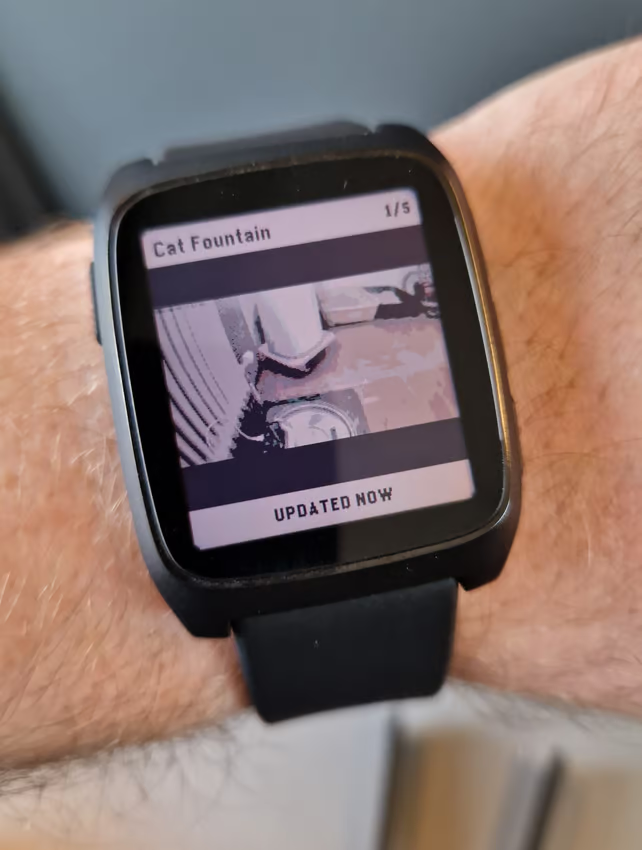
Looks like a mix of color substitution and dithering are used, and I appreciate that it was built to look good in hardware rather than the simulator.
I don’t use my watch for photo viewing, so I was perfectly fine with a limited color space before making the pre-order already.
Build quality-wise, it’s a nicely finished device that has so far withstood environmental abuse and uses more robust materials (aluminium, glass) than the original plastic Pebble. The silicone wrist band that came with it is comfortable and it can be replaced without tools. The attachment points are compatible with tons of 3rd party watch bands, as they use standard construction and dimensions.
I realize that other contemporary smart watches that I dip on due to their poor battery life totally outcompete Pebble devices on the feature front. Features I don’t use after the novelty has worn off aren’t worth the permanent tax on battery capacity in my book, though.
Software🔗
The ecosystem is refreshingly open. There are no barriers to running your own software or even firmware. The new “official” app also supports old Pebble devices, so I can run my original old-school Pebble on top of it as well.
It’s a bit noticeable that it’s a fresh product, because the watch OS sometimes crashes and restarts on its own. The restarts are super quick (like 5 seconds), fortunately, so hardly a disruption.
The watch is intentionally built to be mostly tethered to the phone. It’s totally possible to have self-contained apps running on the watch alone, but the processing power is relatively weak and this would affect battery life. Plus, I don’t really have use cases for standalone operation, so this is a great tradeoff for better battery life in my view.
In the current tech climate, it’s also delightful that the speech features come with a choice between cloud and on-device (on the phone) with local models. Although I don’t use the speech features a lot (feels silly to talk to your wrist), the local model hasn’t made a single transcription mistake so far.
Conclusion🔗
So far, I’m pretty happy and have no regrets. It has only been two weeks, though.
To pass final judgement, I have yet to cover some aspects:
- Long-term use.
- Building my own watch faces and apps.
Can’t think of a watch face I want that’s better than the one I already use, but an app for showing select Grafana metrics would be highly interesting. Haven’t found one yet.
I’ll report back after about a year of use and some software development, or after the watch died - whichever happens faster. Judging by the fact that my original Pebble is still working (with limited battery life), I’m optimistic.
Until then, I won’t stop rubbing the battery life in other smart watch users’ faces.